
AI Directory : AI Agent, AI Code Assistant, AI Models, Large Language Models (LLMs)
What is Gemini 4 Neon?
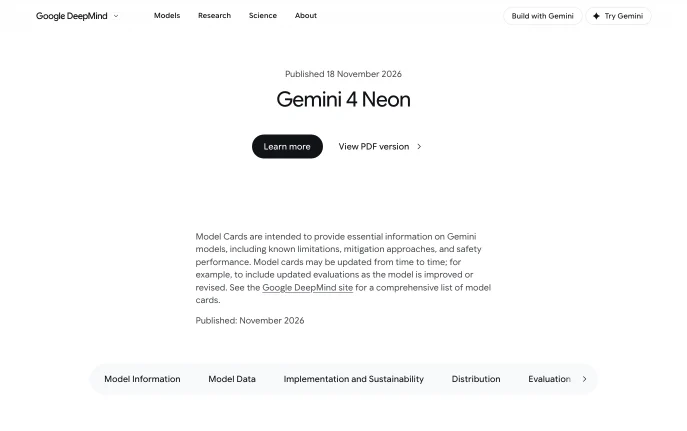
Gemini 4 Neon is a Google DeepMind model released on November 18, 2026. It sits in the middle of the Gemini 4 family: Carbon takes the hardest long-horizon projects, Hydrogen handles fast everyday execution, and Neon is meant to balance depth with speed and cost. Google's model card says it was adapted from Gemini 4 Carbon and is built for complex coding, analytical reasoning and enterprise workflows. It is aimed at developers who call the Gemini API and at Google AI Pro or Ultra subscribers who want a stronger model than the default in the Gemini app.
How to Use Gemini 4 Neon
In the Gemini app, Google AI Pro and Ultra subscribers open the model drop-down and pick Gemini 4 Neon. The Free and Plus plans list only Gemini 4 Hydrogen, so Neon does not appear there. In Google Antigravity, Neon is offered to paid AI Pro and Ultra subscribers.
Developers open Google AI Studio, choose the model ID gemini-4-neon and test prompts before moving to code. The same model is generally available on Google Cloud's agent platform (formerly Vertex AI) on the global endpoint and in the US and EU multi-regions. A paid Gemini API tier is required, because Neon is not offered on the API free tier.
Key Features
- 1M-token context One shared window of 1,048,576 tokens for input and output, with long-decode generation up to the full 1M.
- Adjustable thinking Four thinking levels (low, medium, high and xhigh); high is the default.
- Multimodal input Accepts text, images, video, audio and PDF files and answers in text.
- Agent tools Supports function calling, code execution, computer use, structured outputs, URL context and grounding with Google Search and Google Maps.
- Leaner agent runs Google says it cuts redundant file reads and reports progress while it works, with its lowest fabrication rate yet in internal Antigravity testing.
Why Choose Gemini 4 Neon?
The main reason to pick Neon over Carbon is cost per task. Google reports a 32% lower cost per task than Carbon at the default thinking level, and more secure code than Carbon on easy, medium and hard AutoBaxBench challenges. On Google's own comparison table, Neon scores 61 on the Artificial Analysis Intelligence Index against 59 for Claude Opus 5.5 and 57 for GPT-6.2 Sol, and 70.9% on the Vals Index against 70.1% and 66.1%. The table is not one-sided: Opus 5.5 is slightly ahead on Terminal-bench 4.1 (65.8% vs 65.2%) and FrontierCode 2.0 (47.3% vs 46.2%). These are vendor-published numbers, so test on your own tasks before switching.
Use Cases and Applications
Neon fits long coding sessions in Antigravity, repository-wide refactors that need the 1M-token window, analysis of long PDFs and recordings, and production agents that call tools many times per task. Teams already paying for Carbon can route routine tickets to Neon and keep Carbon for the hardest projects. Its knowledge cutoff is March 2026, so pair it with Search grounding for anything newer.
Frequently Asked Questions
Is Gemini 4 Neon free?
No. In the Gemini app it needs a Google AI Pro or Ultra subscription. On the Gemini API it is paid only: $3.00 per 1M input tokens, $15.00 per 1M output tokens including thinking tokens, and $0.15 per 1M cached input tokens. Batch and Flex processing cost $1.50 input and $7.50 output.
What is the difference between Gemini 4 Neon and Carbon?
Carbon is Google's frontier model for the hardest, longest projects. Neon is adapted from Carbon and trades a little peak depth for lower cost and faster end-to-end completion.
Can I use Gemini 4 Neon in the CLI?
Google's announcement names AI Studio, the Gemini API, Gemini for business, Antigravity and the Gemini app. It does not mention Gemini CLI, so check the CLI's model list before relying on it there.